
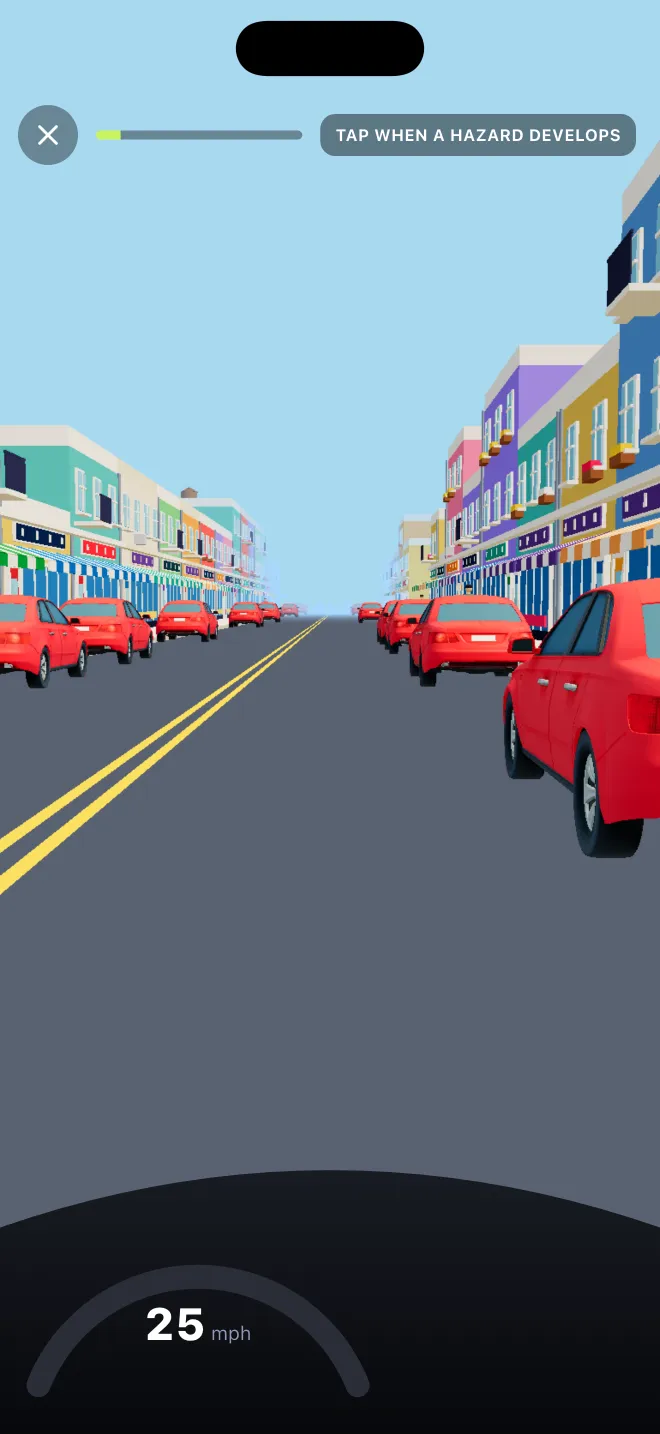
What is the hazard perception test?
The hazard perception test checks whether you notice developing hazards early enough to react safely. A developing hazard is something that would make you take action, such as slowing down, stopping or changing direction. A parked car is a potential hazard; a parked car whose driver pulls out in front of you is a developing one.
In Great Britain it's part of the car theory test. You watch 14 video clips containing 15 developing hazards (one clip has two). Each hazard is worth up to 5 points, and you need 44 out of 75 to pass. You can't go back and review a clip, and clicking constantly or in a pattern scores zero for that clip.
In Australia, each state and territory runs its own hazard perception test, and the format is different from the UK test. Check your state transport website for the details of the test you'll sit.
How hazard perception scoring works
Every developing hazard has a scoring window that opens as the hazard starts to develop. Click early in the window for 5 points; the score drops to 4, 3, 2 and 1 as the window runs on. Click before the window opens and that click doesn't count, which is why many learners click once when they first see a clue and again as it develops.
6 tips to pass the hazard perception test
- Click for developing hazards, not every potential one. Ask yourself: would I need to slow down, stop or steer for this?
- Click again as it develops. Two or three well-timed clicks protect you if your first one was a moment too early.
- Never click in a rhythm. Regular or constant clicking is treated as cheating, and the clip scores zero.
- Scan the whole scene. Check the pavements, side roads, mirrors of parked cars and the road far ahead, not just the car in front.
- Read the clues. Brake lights, a ball in the road, a cyclist looking over their shoulder and a bus at a stop all tell you what's likely to happen next.
- Practise on clips you haven't seen. Repeating the same clips trains your memory, not your eyes. That's the problem Learner Lane was built to fix.
The hazards you'll practise in Learner Lane
Every clip is built around one of six common hazards, placed differently every time: