Alberta Class 7 knowledge test: pass mark, rules and 10 practice questions
· 11 min read
The first Alberta driver's test is the Class 7 knowledge test: 30 multiple-choice questions on the rules of the road and road signs, taken on a computer at a registry agent office. You need 25 right to pass, then a vision test, and you leave with your Class 7 learner's licence. Here's who can take it, what to bring, what it costs, the rules you drive under as a learner, how long until your road test, and 10 practice questions we wrote from Alberta's official Driver's Guide.
What is a Class 7 learner's licence?
It's stage one of Alberta's Graduated Driver Licensing (GDL) program, which every new driver goes through, whatever their age. A Class 7 lets you drive a car or other Class 5 vehicle while a fully licensed driver supervises you, and ride a moped on your own. To get one you must be 14 or older, have a parent or guardian's consent if you're under 18, pass a knowledge test and a vision test, and have valid ID.
| Class 7 learner's licence | Details |
|---|---|
| Minimum age | 14 |
| Under 18 | A parent or legal guardian comes with you and signs a consent form |
| Knowledge test | 30 multiple-choice questions, on a computer |
| Pass mark | 25 out of 30 |
| Retakes | One attempt per day, and you pay for each one |
| Languages | 25, plus audio and oral options |
| Where | Alberta registry agent offices |
| Fee (Oct 2026) | $5.00 government fee plus a service charge of up to $12.60, per attempt |
| Also needed | A vision test, acceptable ID, and a fee for the licence card |
The Class 7 knowledge test
Alberta's knowledge test page sets out the format: 30 multiple-choice questions, and you need 25 out of 30 to pass. That leaves room for five mistakes. The Driver's Guide says the questions are taken from the guide itself, and you'll be asked about safe driving practices, driving laws and road signs. You do the test on a computer at a registry agent office.
You can take the test once per day, and you pay each time you take it. When you pass, take the knowledge test permit you bought for the test to a registry agent so your driver's licence record is updated.

Languages and help with the test
The Class 7 computer test is available in 25 languages: Amharic, Arabic (Modern Standard), Chinese (Simplified), Chinese (Traditional), Cree, Dutch, English, Farsi, French, German, Hindi, Italian, Korean, Oromo, Polish, Portuguese, Punjabi, Russian, Somali, Spanish, Tagalog, Thai, Ukrainian, Urdu and Vietnamese.
- Audio test. A narrated version through headphones. Some registry offices charge for disposable headphones.
- Oral test. A registry agent employee or a professional sign language interpreter reads the questions and answers out loud. All oral tests are in English.
- English conversion dictionary. If you need minimal help with English, you can use a paper one for the Class 7 test.
- Translator. You first need three attempts using the available options before you can request one. If your language isn't offered on the computer at all, you can bring a translator with a valid Translation Identification Number (TIN) to your first test instead.
How much does the Class 7 test cost?
At the time of writing, the Government of Alberta's Registry Agent Product Catalogue (effective October 1, 2026) lists a $5.00 government fee for a knowledge test in any class, including the other languages, plus a registry service charge of up to $12.60. That's up to $17.60 per attempt, and each retake is charged again. The service charge is a maximum, so some registries may charge less. Oral tests have a higher maximum service charge, $26.25.
The licence card is a separate purchase once you pass. Class 5 road test fees are set by each registry agent, which has to publish them online, so check with the one you plan to use.
What to bring to the registry agent
For a first Alberta licence, the registry agent needs documents that prove who you are, that you live in Alberta, and that you're legally entitled to be in Canada. Alberta's ID requirements page gives examples:
- Proof of identity, such as a Canadian passport (expired less than a year ago is accepted). Debit, credit and Social Insurance Number cards, temporary licences and membership cards aren't accepted.
- Proof you live in Alberta, such as a utility bill, bank statement or lease with your full name and Alberta address, dated within the last 90 days.
- Proof of legal entitlement, such as a Canadian birth certificate, Canadian passport, citizenship certificate, Permanent Resident Card, or a Government of Canada permit or visa that gives you resident status for more than the next 90 days.
- A parent or legal guardian, if you're under 18. They must come with you, show proof of guardianship and sign a consent form. They can withdraw consent in writing until you turn 18, which suspends the licence.
- Your glasses or contact lenses, if you wear them, for the vision test.
- Payment for the test and, once you pass, the licence card.
Documents must be in English, or come with a written translation from an approved translator. You must also disclose any medical or physical condition that could affect your driving. If you have one, you submit a Driver Medical Intake Form completed by a doctor or nurse practitioner.
The vision test
Once you've passed the knowledge test, the registry agent tests your vision to check it's good enough to drive. If you don't meet the standard, you're referred to an optometrist or ophthalmologist to complete a Vision Referral form. If you need glasses or contacts to meet it, your licence gets a condition code saying so.
Pass both tests and you can buy your Class 7 licence card. You get a temporary licence that's valid for 30 days or until the card arrives in the mail, which should take about 21 business days.
Class 7 restrictions in Alberta
These are the conditions on alberta.ca and in the Driver's Guide for every Class 7 learner:
| Rule | What it means |
|---|---|
| Supervising driver | Someone 18 or older with a full (non-GDL) Class 5 licence or higher, sitting in the front passenger seat. A probationary GDL driver can't supervise you. |
| Hours | No driving between midnight and 5 a.m. |
| Passengers | No more people in the vehicle than there are seat belts. |
| Alcohol and drugs | Zero alcohol and drug level whenever you drive. |
| Demerits | Your licence is suspended at 8 demerit points. |
| Time as a learner | At least 12 months before the Class 5 road test, extended if you're suspended. |
Three offences carry 2 demerit points just for GDL drivers: driving between midnight and 5 a.m. (Class 7 only), having more passengers than seat belts, and driving with a supervisor who isn't fully qualified.
Zero means zero. At the time of writing, the Driver's Guide says that under the IRS ZERO: Novice program, a Class 7 or Class 5-GDL driver caught with any alcohol or drugs faces an immediate 30-day licence suspension, a seven-day vehicle seizure and a $200 fine plus a 20 per cent victim fine surcharge.
How long do you hold a Class 7 before the road test?
You need to hold your Class 7 for at least 12 months and be 16 or older before you can take the Class 5 road test. Under 18, you again need a parent or guardian's consent. A suspension extends the 12 months. Pass the road test and a second vision test, and you get a probationary Class 5-GDL licence.
You book the Class 5 road test through a registry agent. It takes about 45 minutes, and you fail with more than 75 points for errors. Some mistakes fail you automatically, whatever your points, such as speeding, not stopping completely at a stop sign or before turning right on a red light, and failing to yield the right-of-way.
| Stage | How long | To move on |
|---|---|---|
| Class 7 (learner) | At least 12 months | Be 16 or older and pass the Class 5 road test |
| Class 5-GDL (probationary) | At least 2 years, or up to 6 months less with an approved driver training course | Be 18 or older, with no suspensions or demerits in the last 12 months. No exit road test since April 1, 2023. |
Alberta says it takes a minimum of 3 years to get a full, non-GDL Class 5 licence. Driver training is recommended but not mandatory. A Class 5 or Class 6 course from a licensed driver training school can cut up to six months from the probationary stage; the official pages don't describe any way to shorten the 12-month learner stage. The Class 5 licence page lists the probationary rules: no more passengers than seat belts, a suspension at 8 demerit points, zero alcohol and drugs, no commercial licence upgrades, and you can't supervise a learner.
Alberta Class 7 practice test: 10 questions
We wrote these 10 questions ourselves from rules stated in Alberta's Driver's Guide, with extra weight on rules that are specific to Alberta. They aren't from the real test, but they check the kind of facts it covers: Class 7 conditions, zones and times, right-of-way and the numbers. Answer each one before you open the answer.
- You hold a Class 7 learner's licence. During which hours are you not allowed to drive?A. 10 p.m. to 6 a.m.B. Midnight to 5 a.m.C. Sunset to sunriseD. 1 a.m. to 5 a.m.
Show answer
B. Class 7 learners must not drive between midnight and 5 a.m. Breaking that curfew is a 2-point demerit offence. - Who can supervise you while you drive with a Class 7 licence?A. Any licensed driver aged 16 or over, in any seatB. A Class 5-GDL (probationary) driver who is 18 or olderC. A fully licensed (non-GDL) driver aged 18 or older, sitting in the front passenger seatD. Any adult, licensed or not, as long as they sit beside you
Show answer
C. Your supervisor must be 18 or older, hold a full (non-GDL) Class 5 licence or higher, and sit next to you. A probationary GDL driver can't supervise a learner. - As a Class 7 learner, how many people can you have in the vehicle?A. Only your supervisorB. No more people than there are seat beltsC. Your supervisor plus immediate familyD. Any number, as long as you stay under the speed limit
Show answer
B. You can't drive with more people than there are seat belts. Having more passengers than seat belts is a 2-point demerit offence for GDL drivers. - A school zone sign has a speed limit but no times posted under it. When is the zone in effect?A. 24 hours a day, every dayB. On school days, 8:00 to 9:30 a.m., 11:30 a.m. to 1:30 p.m. and 3:00 to 4:30 p.m.C. On school days, 8 a.m. to 5 p.m.D. Only when you can see children
Show answer
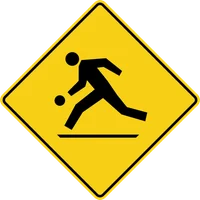
B. Those are the standard school zone times, on school days only. A town or city that sets different times posts them under the sign. The limit is 30 km/h unless otherwise posted. - Unless other times are posted, when is a playground zone in effect?A. On school days, 8 a.m. to 4:30 p.m.B. Every day, from 8:30 a.m. to one hour after sunsetC. Every day, from dawn to duskD. Only in July and August
Show answer
B. Playground zones apply every day from 8:30 a.m. to one hour after sunset, at 30 km/h unless otherwise posted. You also can't pass a vehicle going the same way while the zone is in effect. - The limit is 100 km/h. A tow truck is stopped ahead with its lights flashing, and you're in the lane next to it. What's the fastest you may pass it?A. 40 km/hB. 60 km/hC. 80 km/hD. 90 km/h
Show answer
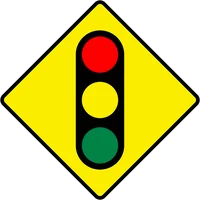
B. Slow to 60 km/h, or the posted limit if it's lower, in the lane next to emergency vehicles or tow trucks stopped with their lights flashing. Speeding fines are doubled there. - In Alberta, what does a flashing green traffic light mean?A. It's pedestrian-controlled, so treat it as a stop signB. You may go through, turn left or turn right without stopping, still yielding to pedestrians and vehicles lawfully in the intersectionC. Treat the intersection as a four-way stopD. The light is about to turn red, so stop if you can
Show answer
B. Opposing traffic faces a red light, so you can go straight or turn either way without stopping. You still yield to pedestrians or vehicles lawfully in the intersection. Don't assume another province's rule applies here. - There's no speed limit sign on a provincial highway outside an urban area. What's the maximum speed?A. 80 km/hB. 90 km/hC. 100 km/hD. 110 km/h
Show answer
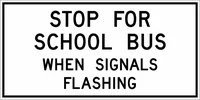
C. Unless otherwise posted, it's 100 km/h on a provincial highway outside an urban area, 80 km/h on a provincial highway inside a city's limits or on other roads outside urban areas, and 50 km/h on roads in an urban area. - On a two-lane undivided highway, a school bus coming toward you stops with its red lights flashing and its stop sign out. What do you do?A. Slow down and pass carefully, because you're not behind itB. Stop about 20 metres from the bus and wait until the red lights stop flashing and the stop sign is pulled inC. Stop only if children are on your side of the roadD. Sound your horn and keep going
Show answer
B. On an undivided highway, traffic from both directions stops about 20 metres away and stays stopped until the red lights are off and the stop sign is no longer extended. Only on a highway divided by a median may oncoming traffic proceed with caution. - Driving at night, how close to an oncoming vehicle can you be before you must switch to low beams?A. 100 metresB. 150 metresC. 300 metresD. 500 metres
Show answer
C. Use your low beams within 300 metres of oncoming vehicles, and when you're following within 150 metres of another vehicle.
Want more? Take the free Canada practice test and browse the Canada road signs guide. Moving from another province? Compare Ontario's G1 test and B.C.'s ICBC knowledge test. Rules differ between provinces, so study Alberta's guide for this one.
How to study for the Class 7 knowledge test
- Read the Driver's Guide, cover to cover. The questions come from it. The 2026 edition of the Driver's Guide: cars and light trucks is free to download from the Government of Alberta, and there's a French version, the Guide du conducteur.
- Start with the licensing chapter. The Class 7 and GDL conditions are in chapter 1, and they're fair game: curfew hours, supervisor rules, passengers, demerits and zero alcohol.
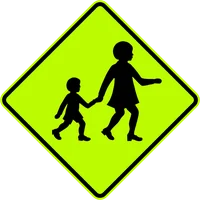
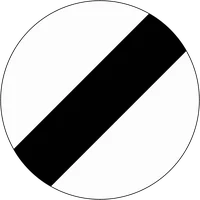
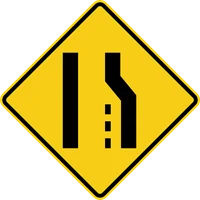
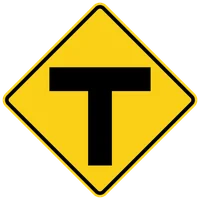
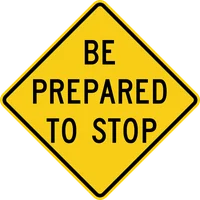
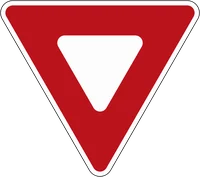
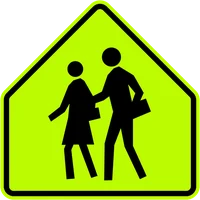
- Learn signs by shape and colour. A red circle with a slash means the action isn't allowed, yellow diamonds warn of hazards, orange diamonds mean construction, a fluorescent yellow-green pentagon marks a school zone or area, green rectangles give directions and distances, and blue squares point to services like fuel and food.
- Make a list of Alberta's numbers. 50 km/h in urban areas and 100 km/h on rural provincial highways when nothing is posted, 30 km/h school and playground zones and their hours, 60 km/h past stopped emergency vehicles and tow trucks, 150 metres behind emergency vehicles, two seconds of following distance, 20 metres from a stopped school bus, 5 metres from a hydrant, stop sign or marked crosswalk when parking, and low beams within 300 metres.
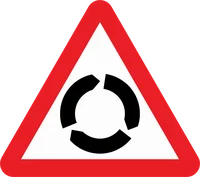
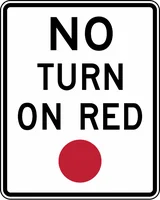
- Get the intersection rules straight. At an uncontrolled intersection, yield to the vehicle on your right. At a four-way stop, the first vehicle there goes first, and if two arrive together, the one on the right goes. In a circle, yield to traffic already in it. Right on red is allowed after a full stop unless a sign says no; left on red only from a one-way street onto a one-way street.
- Read every word. With five mistakes allowed, one missed "not" or "unless" can cost you the pass.
- Practise until 25 out of 30 feels easy. Aim well above the pass mark so nerves on the day don't matter, and remember you can only try once a day.
How Learner Lane helps, and what it isn't
Learner Lane is an independent app for iPhone and Android. It isn't affiliated with the Government of Alberta or any registry agent, and its questions aren't taken from the real test or the Driver's Guide. What it does is teach the rules inside short 3D driving situations: you make the call, see the consequence, and rewind. It has hazard perception clips, road rules quiz questions and road signs by country, including real Canadian signs, plus a driving hours log to track your supervised practice during your Class 7 year. It's free to start, and Pass Pass is a one-time purchase.
Sources
Checked 6 November 2026:
- alberta.ca: Get a Class 7 learner's licence
- alberta.ca: Steps to getting your licence
- alberta.ca: Knowledge test
- alberta.ca: Class 5 driver's licence
- alberta.ca: Road test
- alberta.ca: ID requirements for licences and identification cards
- Government of Alberta: Driver's Guide: cars and light trucks (2026 edition, published May 2026, updated June 15, 2026)
- Government of Alberta: Registry Agent Product Catalogue (effective October 1, 2026)
Rules and fees change, so check them before your test. Learner Lane is not affiliated with the Government of Alberta or any registry agent.
This guide summarizes common rules. Laws vary by country, state and province, and change over time: check your official driver handbook. Learner Lane is not affiliated with any government licensing authority.