NSW Driver Knowledge Test (DKT) practice test: pass mark, cost and 10 questions
· 10 min read
The Driver Knowledge Test, or DKT, is the learners test in NSW: the road rules test you must pass before you can get your learner licence (your Ls). You can take it online at home or in person at a service centre, and the two versions work quite differently. Here's how many questions there are, how many you need to get right, what it costs, what to bring, and what happens once you pass, checked against Transport for NSW and Service NSW. At the end there are 10 practice questions to test yourself.
What is the Driver Knowledge Test (DKT)?
The DKT is the test you must pass to apply for a C class (car) learner licence in NSW. It checks that you know the road rules and safe driving behaviour. It's the first of three tests on the way to a full licence: the DKT, then the Hazard Perception Test, then the driving test.
Everything in it comes from the Road User Handbook, which Transport for NSW says aims to prepare you for the DKT. If you only read one thing, read that.
Learning in another state or territory? Each one runs its own learner test with its own rules, so check with your local transport authority. This guide covers NSW only.
How many questions are on the DKT, and how many do you need to pass?
The in-person DKT is a multiple-choice computer test with 45 questions, drawn at random from a much larger question bank. Transport for NSW has published the pass mark as:
| Section | Questions | You need |
|---|---|---|
| General knowledge | 15 | At least 12 correct |
| Road safety (including traffic signs) | 30 | At least 29 correct |
You need to pass both sections, so the test can end as soon as you get 4 general knowledge or 2 road safety questions wrong. These figures come from earlier editions of the official DKT page and Road User Handbook; the current pages don't restate them, so take them as the standard to aim for rather than a promise. In practice, the road safety section leaves room for only one mistake, so aim to know every answer.
For the DKT online, Transport for NSW doesn't publish the number of questions or the pass mark for the test at the end of the course. Your result is recorded automatically, and if you don't pass you can go back over the modules and retake the test after 12 hours, as many times as it takes.
DKT online or in person: which should you do?
Most learners can choose. The official DKT page sets out the differences:
| DKT online | DKT in person | |
|---|---|---|
| Where | At home, or anywhere with internet | At a service centre, after you book |
| Minimum age | 15 years and 11 months to enrol | 16 |
| Format | 4 to 6 hour interactive course with quizzes, then a test | 45-question multiple-choice computer test |
| Fee | One fee for unlimited attempts, paid when you apply for your Ls | A fee every time you sit it |
| If you fail | Retake after 12 hours | Re-sit the same day if a booking is free, and pay again |
| Languages | English, Simplified and Traditional Chinese, Arabic, Spanish, Vietnamese, Korean, Thai and Farsi | English, Greek, Turkish, Croatian, Serbian, Arabic, Simplified Chinese, Korean, Spanish and Vietnamese |
You need to book the in-person test if you:
- need an interpreter, an Auslan interpreter or a language that isn't offered online
- have been disqualified, suspended or refused a licence
- already hold a current NSW or interstate driver licence (rider-only licences aside)
- don't have internet access, or simply prefer to sit it in person
For the DKT online you also need a MyServiceNSW Account and an Australian identity document to enrol, and you must live in NSW. You get 12 months' access to the course. A free interpreter service for the in-person test is available on 13 22 13, and service centre staff can read the questions aloud if you have trouble reading.
How old do you have to be to do the learners test in NSW?
You can enrol in the DKT online at 15 years and 11 months, but you can only apply for your learner licence once you're 16. The in-person DKT is for people aged 16 or over. Either way, you're on your Ls at 16 at the earliest.
How much does the DKT cost?
At the time of writing (October 2026), these are the NSW fees effective from 1 July 2026:
| Item | Fee | When you pay |
|---|---|---|
| DKT online | $58 | Once, for unlimited attempts, when you apply for your learner licence |
| DKT in person | $58 | Every attempt, when you book |
| Learner licence (car) | $32 | When you apply at the service centre |
Fees change, so check the official page before you go. The fee can be waived for people in the Driver Licensing Access Program, which helps people from disadvantaged backgrounds and Aboriginal communities get licensed.
What to bring to the DKT and to get your Ls
For the in-person test, the Service NSW booking page says to bring:
- a completed Licence Application form
- your glasses or contact lenses, if you wear them
- your proof of identity documents (commemorative certificates aren't accepted)
If you passed online, you still visit a service centre to apply for your licence. No booking is needed. Bring your Photo Card or proof of identity documents and proof of signature, a completed Licence Application form, your payment, your glasses or contacts if you wear them, your concession card details if you have one, and a Fitness to Drive medical assessment if you have a condition that affects your driving.
The eyesight test
Before you get your Ls, you must pass an eyesight test at the service centre, which is why you bring your glasses or contact lenses. You also have your photo taken for your licence card and leave with a temporary paper licence; the card is posted to you.
After you pass: your learner licence, L plates and log book
With your Ls you can start driving with a supervisor. The learner licence rules include:
- A supervisor every time, sitting next to you, who holds a full Australian driver licence. Someone on a learner, P1, P2 or overseas licence can't supervise you.
- L plates displayed clearly on the front and back of the car.
- A 90 km/h maximum, even where the speed limit is higher.
- Zero alcohol in your system.
- No mobile phone while driving or stopped but not parked, including hands-free and loudspeaker.
- No towing, and no driving in Parramatta Park, Moore Park or Centennial Park.
Your learner licence is valid for 5 years. If it expires, you have to pass the DKT again.
Log book hours
If you're under 25, you must log at least 120 hours of supervised driving, including 20 hours at night (between sunset and sunrise), and hold your Ls for at least 12 months before the driving test. You record them in the paper Learner Driver Log Book you get with your licence, or in Roundtrip, the log book app Transport for NSW accepts. Two things can speed it up:
- 3 for 1 lessons: each hour with a NSW-licensed driving instructor counts as 3 hours, up to 10 instructor hours (20 bonus hours). Bonus hours count as daytime hours only.
- The Safer Drivers Course: 20 hours of log book credit when you complete it.
If you're 25 or over, you don't have to log hours, though you should still get plenty of practice. Next comes the Hazard Perception Test, which under-25s can take after 10 months on their Ls. Our NSW driving test guide covers that and the drive itself.
10 DKT practice questions (with answers)
We wrote these ourselves from the rules in the Road User Handbook. They aren't from the official question bank, but they test the same kind of knowledge. Cover the answers and see how you go.
- You're on your Ls on a motorway signposted 110 km/h. What is the fastest you may drive?A) 80 km/hB) 90 km/hC) 100 km/hD) 110 km/hAnswer: B. Learners must never drive above 90 km/h, even where the speed limit is higher.
- You turn into a street with houses and street lights but no speed limit sign. What is the speed limit?A) 40 km/hB) 50 km/hC) 60 km/hD) 70 km/hAnswer: B. With no sign, the default limit in a built-up area (street lights and buildings less than 100 m apart) is 50 km/h.
- In good conditions, what is the minimum gap you should keep behind the vehicle in front?A) 1 secondB) 2 secondsC) 3 secondsD) One car lengthAnswer: C. The handbook's crash avoidance space is at least 3 seconds, and more at higher speeds or in poor conditions.
- You're a learner stopped at a red light and your phone rings in its cradle. What may you do?A) Answer it on speakerB) Answer it while the light is redC) Leave it: you can't use it while drivingAnswer: C. Learners must not use a mobile phone while driving, even when stopped at lights, and that includes hands-free.
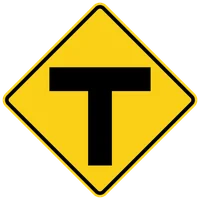
- The road you're on ends at a T-intersection with no signs. Who gives way?A) You, to vehicles on the continuing roadB) Whoever arrives lastC) Vehicles on the continuing road, to youAnswer: A. On a road that ends at a T-intersection, you give way to all vehicles on the continuing road unless a sign says otherwise.
- You arrive at a roundabout. Which vehicles must you give way to?A) Only vehicles approaching from your leftB) All vehicles already in the roundaboutC) None, if you got there firstAnswer: B. You slow down or stop to give way to every vehicle already in the roundabout.
- You're about to pass a stopped ambulance with its lights flashing on a 60 km/h road. What is your limit?A) 20 km/hB) 40 km/hC) 60 km/hAnswer: B. Where the limit is 80 km/h or less, slow to 40 km/h when passing a stopped emergency vehicle with flashing blue or red lights.
- No sign says otherwise. How close to an intersection with traffic lights may you park?A) Within 10 mB) No closer than 20 mC) Anywhere outside the crossingAnswer: B. You must not park within 20 m of an intersection with traffic lights (10 m if it has no lights).
- You're driving on high beam at night. When must you switch to low beam?A) When an oncoming vehicle is within 200 m, or you're 200 m or less behind another vehicleB) Only in built-up areasC) Only when another driver flashes their lights at youAnswer: A. Dip to low beam when a vehicle coming towards you is within 200 m, or when you're 200 m or less behind another vehicle.
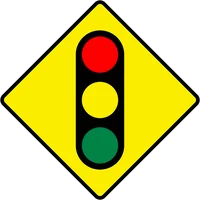
- The lights turn yellow as you approach, and you can stop safely before the stop line. What must you do?A) Speed up to get throughB) StopC) Go through, because yellow means cautionAnswer: B. A yellow light means stop. You may only go through if you can't stop safely before the line.
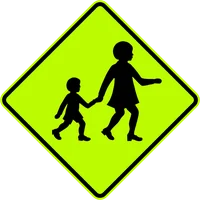
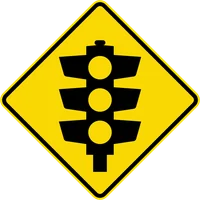
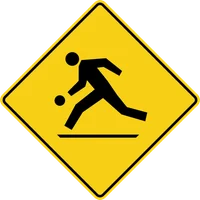
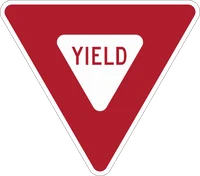
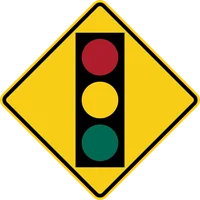
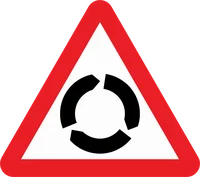
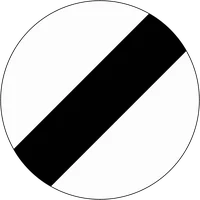
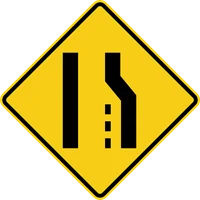
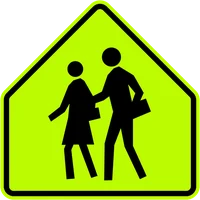
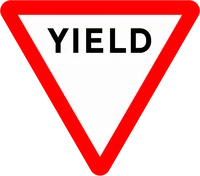
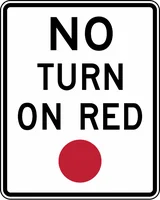
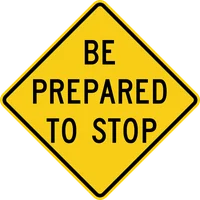
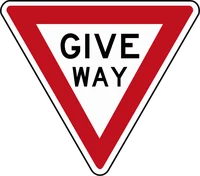
Some rules are easier to learn from the sign itself. Three worth knowing on sight:
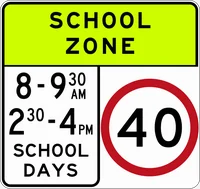
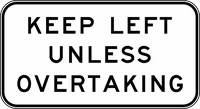
For more, try our free Australia practice test and the full list of Australian road signs.
How to pass the DKT first time: 7 tips
- Read the Road User Handbook. It's written to prepare you for the DKT, and every rule in the test is in it.
- Use the right practice for your version. Transport for NSW's NSW Practice Test is for the in-person DKT. Service NSW says not to use it to study for the DKT online; the online course has its own quizzes.
- Go through the official question list. Transport for NSW publishes its car DKT questions as a PDF, grouped into general knowledge, road safety and traffic signs.
- Learn the numbers. Speed limits, distances and the learner rules are easy marks if you know them and easy to lose if you guess: 90 km/h for learners, 50 km/h in built-up areas, 40 km/h in school zones, 3-second gaps, 10 and 20 metre parking distances.
- Read every word. Many wrong answers come from missing a "not" or answering the question you expected.
- Aim for perfect, not a pass. With room for just one road safety mistake, "mostly right" isn't enough.
- See the rules, not just read them. Give way rules at T-intersections and roundabouts stick faster when you've watched them play out.
How Learner Lane helps, and what it isn't
Learner Lane is an independent app. It isn't the DKT online course or the official question bank, and it isn't connected to Transport for NSW or Service NSW. What it does is teach the rules inside short 3D driving situations, set up with real Australian signs and rules: you make the call, see the consequence and rewind. Chapters cover road signs, traffic lights, right of way, weather and night driving, and sharing the road, with road rules quiz questions along the way.
Once you're on your Ls, its driving hours log tracks your supervised day and night hours so you can see what's left. It isn't an official log book, so keep recording your hours in the paper log book or Roundtrip too. It also plans practice routes on real roads around your test centre, with turn-by-turn voice directions. It's free to start, and a one-time Pass Pass purchase unlocks everything.
Facts from Transport for NSW and Service NSW: the Driver Knowledge Test, DKT online, learner driver licence and fees pages and the Road User Handbook, checked 27 October 2026. Learner Lane is not affiliated with Transport for NSW or Service NSW.
This guide summarizes common rules. Laws vary by country, state and province, and change over time: check your official driver handbook. Learner Lane is not affiliated with any government licensing authority.