The New York road test: what to bring and what to expect
· 6 min read
A New York road test is the behind-the-wheel exam the New York State DMV gives before you get your driver's license: an examiner beside you, a car that has to pass their checks, and a route you haven't seen. Here's what to bring, what the examiner watches, and how to practice before the day.
What the New York road test involves
The examiner rides with you and watches how you drive, not how perfectly you park. The same five things are scored everywhere in the US: observation (mirrors and blind spots), control (steering, braking, speed), the rules (full stops, right of way, signals), space (following distance and lane position) and judgment when something unexpected happens.
Which streets you drive is up to the examiner. New York doesn't publish its road test routes, so any route map online is guesswork. The area around the test site doesn't change, though, and that's what you can learn. Our guide to driving test routes explains why no state publishes them.
What to bring to a New York road test
The New York DMV asks you to bring:
- Your physical photo learner permit
- Your glasses or contact lenses, if your permit says you need corrective lenses
- Your original Pre-licensing Course Certificate (MV-278). Copies aren't accepted.
- If you're under 18, a Certification of Supervised Driving (MV-262) completed by your parent or guardian
- An accompanying driver over 18 if they drive you to the site, or over 21 if you drive there, with a physical driver's license valid for the test vehicle. A mobile ID isn't accepted.
- A vehicle with valid registration, insurance and inspection that works properly, is clean and has permanent license plates
Two smaller rules catch people out: only the accompanying driver may come to the test site with you, and if you arrive late the examiner may not be able to test you. The full checklist, including the car checks, is in what to bring to your driving test.
How to practice before the day
- Drive the streets around your test site. In Learner Lane you pick your DMV and the app plans practice routes on the real roads around it, kept off highways and toll roads, with turn-by-turn voice directions. Save each drive to your driving hours log and it counts towards your supervised hours.
- Go at the time of your appointment. Rush hour, the school run and a quiet mid-morning are different roads, and a junction that feels easy at 10 a.m. can be a hard left turn at 4 p.m.
- Practice the rules you'll meet, not just the turns. Run the free US practice test until signs and right of way are automatic, then rehearse the decisions in 3D: a yellow light, a 4-way stop, a stopped school bus.
- Keep your hours log current. New York wants your MV-262 signed by a parent or guardian if you're under 18, and filling it in from memory the night before is harder than logging each drive as you go.
New York rules that come up on the test
A few New York specifics are worth knowing cold, because the examiner will see them in the first ten minutes:
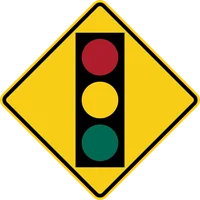
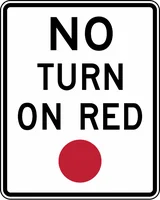
- Right on red in New York City is illegal unless a sign at the intersection says otherwise. Elsewhere in the state, stop completely first, then turn if the way is clear. A red arrow is its own rule: in New York you may not turn on one unless a sign allows it. Right turn on red covers every exception.
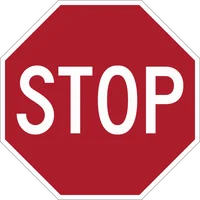
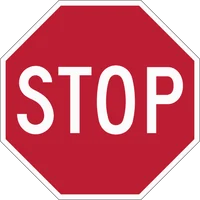
- Full stops. Wheels stopped, behind the line or crosswalk, before you look and go. A rolling stop is one of the most common ways to fail. The 4-way stop rules cover who goes first.
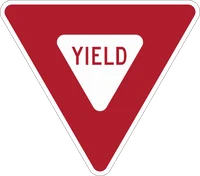
- Right of way. New York's driver manual puts the car on the right first when two arrive together, and gives pedestrians in the crosswalk the way. Turning left, you yield to oncoming traffic.
On test day
- Arrive up to 15 minutes early, with the documents and the car ready
- Adjust your seat and mirrors before you pull out, and put your phone away
- Turn your head for mirror and blind-spot checks, so the examiner can see them
- Signal every turn and lane change, cancel it afterwards, and stay at or near the limit
If a mistake happens, drive on safely. One minor error doesn't fail you; three more while you panic about it can. Our guide to passing your road test covers the rest of what examiners score, and hazard perception practice trains the early spotting that makes a city test feel calmer.
This guide summarizes common rules. Laws vary by country, state and province, and change over time: check your official driver handbook. Learner Lane is not affiliated with any government licensing authority.