Driving test routes: why there's no official list, and how to practise
· 7 min read
Search for "driving test routes" and you'll find maps for almost every test centre. It's natural to want to know exactly where you'll be driving. But there's no official list to learn, and that changes how you should prepare. Here's why, how the test drive actually works, and how to practise the roads around your test centre so nothing on the day feels new.
Are driving test routes published?
Not any more. Until 2010, the Driving Standards Agency (now the DVSA) put each test centre's routes online. It stopped when new routes came in that October, the same month independent driving joined the test. The reason given was simple: learning test routes by rote isn't the same as learning to drive.
Today GOV.UK is direct about it: driving test routes are not published, so you can't check them before your test. Your examiner chooses the route on the day, and can take you anywhere around the test centre.
How the UK driving test drive works
Knowing the format matters more than knowing the turns. According to GOV.UK, the test has four parts:
| Part | What happens |
|---|---|
| Eyesight check | A check of your eyesight before you drive. |
| Show me, tell me | Vehicle safety questions about the car you're driving. |
| General driving | Around 35 minutes of driving, including pulling over and pulling away, a normal stop at the side of the road and a hill start. You might also be asked to do an emergency stop. |
| Reversing | One exercise reversing your vehicle. |
Independent driving: sat nav or signs
Part of the general driving is independent driving, which GOV.UK puts at 20 to 35 minutes. You follow directions from a sat nav, from traffic signs, or a mix of both. The examiner decides which, and sets up the sat nav for you: you can't use your own. When sat navs came into the test in 2017, the DVSA said it doesn't matter which make or model you practise with.
Wrong turns aren't faults
GOV.UK says the examiner will not give you a fault for taking a wrong turning, and will help you get back on the route. What's marked is how you drive. You can pass with up to 15 driving faults ("minors") and no serious or dangerous faults ("majors"). A sudden swerve to make a missed exit is a far bigger problem than the missed exit itself.
What this means for learners
If the route can change, memorising one loop gives you false confidence. The roads near a test centre don't change, though. The same roundabouts, junctions, speed-limit changes and school zones turn up on almost every test from that centre, in different orders. Learn those well and the order doesn't matter.
How to find and practise the roads near your test centre
- Map the area. Open a map around your test centre and look at the roads leading out of it: the nearest roundabouts, busy junctions, dual carriageways, and places where the speed limit changes.
- Drive it with your instructor or a supervising driver. Ask them which spots learners tend to find hard, and go back to those more than once.
- Go at the time of day of your test. Rush hour, the school run and a quiet mid-morning feel like different roads.
- Practise both kinds of directions. Follow a sat nav to somewhere you don't know, then follow road signs to a named place. Both can come up in independent driving.
- Vary your loops. Approach the same roundabout from every direction. That's what makes you ready for whichever route the examiner picks.
- Note your trouble spots. After each drive, write down the junction or lane choice that caught you out, and practise it next time.
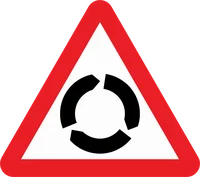
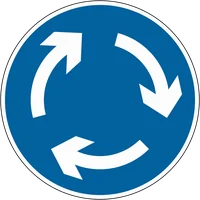
Image: Government of the United Kingdom – Department for Transport, OGL v1.0
Image: Government of the United Kingdom – Department for Transport, OGL v1.0
Unofficial route maps made by instructors and apps can help you get to know an area. Just treat them as practice: your examiner isn't bound to any list.
DMV road test routes (US)
In the US, the road test (also called the drive test or behind-the-wheel test) is run by each state, so there's no national list of DMV test routes. What states do publish is what the examiner scores, which is more useful anyway. California's DMV, for example, starts with a pre-drive safety check of your car and then a behind-the-wheel evaluation, using the same published criteria for every examiner. Its critical driving errors, which fail you outright, include:
- Any action that makes the examiner step in, physically or verbally
- Going through a stop sign or flashing red light above a brisk walking speed
- Not checking mirrors or your blind spot when changing lanes, merging, backing or pulling from the curb
- Driving 10 mph over or under the speed limit without a good reason
- Turning from the wrong lane
So practise the way UK learners do: drive the streets around your DMV office, at the time of your appointment, and rehearse every maneuver your state tests. Our guide on how to pass your road test covers what examiners look for, and a test-day checklist.
Practice routes in Learner Lane
Learner Lane's practice test routes are built for exactly this. Pick your test centre or DMV, and the app plans routes on the real roads around it, avoiding motorways, highways and toll roads. Turn-by-turn voice directions on a live map guide a supervised practice drive, and you can save each drive to your driving log. Your first route is free, and Pass Pass unlocks the rest.
These are practice routes, not official test routes: as above, there's no official list to copy. They're a way to cover the area around your centre, so the roads on test day are ones you know.
Know the rules before the route
A familiar road only helps if your decisions on it are right. Run through the free UK practice test, and train your eyes with hazard perception practice, so you spot what's developing on any road the examiner picks.
This guide summarizes common rules. Laws vary by country, state and province, and change over time: check your official driver handbook. Learner Lane is not affiliated with any government licensing authority.