NSW Hazard Perception Test (HPT): how it works, what it costs and how to prepare
· 12 min read
The NSW Hazard Perception Test (HPT) is a touch-screen computer test you sit at a Service NSW centre before you can book the driving test for your P1 licence. You watch 15 short video clips, after 2 practice clips, and touch the screen when you would slow down, overtake or turn at an intersection. If you're under 25, you can take it once you've held your learner licence for 10 months; at 25 or over, whenever you're ready. Here's how each clip works, what Transport for NSW does and doesn't say about scoring, how to book, what happens if you fail, and the gaps, distances and scanning habits its Hazard Perception Handbook teaches, with six practice scenarios at the end.
What is the NSW Hazard Perception Test?
The HPT measures how well you recognise potentially dangerous situations on the road and react to them. It's the second of three tests on the way to your Ps: the Driver Knowledge Test gets you your learner licence, and you must pass the HPT before you can sit the driving test. That applies at every age.
The clips are built around the crashes new drivers actually have. According to the Hazard Perception Handbook, almost 80% of NSW casualty crashes (where someone is killed or injured) fall into five types, and these are also the most common crashes for provisional drivers:
- Hitting the back of another vehicle (a rear-end crash).
- Colliding with a vehicle coming from the left or right.
- Colliding with a vehicle coming from the opposite direction.
- Running off a straight road and hitting an object or parked vehicle.
- Running off the road on a curve or bend and hitting an object or parked vehicle.
To match, the HPT assesses three basic skills: keeping a safe distance from other vehicles, selecting safe gaps, and identifying hazards. The rest of this guide is about those three.
When can you take the HPT?
The rules from Service NSW and Transport for NSW depend on your age:
| Under 25 | 25 or older | |
|---|---|---|
| Licence you need | A current NSW learner licence | A current NSW learner licence |
| Time on your Ls first | At least 10 months | None: sit it when you feel ready |
| How long a pass lasts | 15 months | 15 months |
The 15 months matter. Once you've passed the HPT, you must pass the driving test within 15 months, or you have to sit the HPT again. Under-25s can't sit the driving test until they've held their Ls for 12 months, so there's no prize for doing the HPT the day you hit 10 months. The handbook's advice: there's no hurry, so attempt it only when you feel ready.
How the HPT works, step by step
The handbook walks through the test from the moment you arrive:
- Checks. At the service centre, staff check your licence details and that you're eligible, and you prove your identity.
- The kiosk. You sit at a test kiosk with a touch-screen computer or a portable laptop. Everything is done by touching the screen, so you don't need to know your way around computers.
- Instructions. A welcome screen and instructions explain the test. You can switch on the sound (there's a round green speaker button) and ask for headphones to hear everything read aloud.
- 2 practice clips. They work just like the real ones, but you get feedback afterwards: your response was good, could have been better, or was unsafe. If it wasn't good, you can try that clip again.
- 15 test clips. They're chosen at random from a larger pool. You see each one only once and can't change your response, just like real driving. There's no feedback until all 15 are done.
- Your result. A screen tells you whether you passed or failed and what you could improve. Let the staff know you've finished, and ask them if you want a printed copy.
What happens in each clip
Every clip is filmed from the driver's seat. First you're told the situation and what the driver wants to do, and you see a still picture for 3 seconds before the clip starts moving. The handbook's own example:
You are driving along a 2-way street in a 60km/h speed zone. You wish to keep driving straight ahead. Touch the screen when you would slow down.
The dashboard shows your speed and whether your indicators are on. During the clip, you touch the screen if and when you think an action is needed, such as slowing down, overtaking, or turning or crossing at an intersection. When the computer records your touch, you hear a sound and the picture flashes. The clip may keep playing for a few more seconds, but you don't need to touch again. After each clip, you confirm with one of two buttons: "You touched the screen" or "You did not touch the screen".
The key point most people miss: sometimes the right answer is not to touch at all. Just like real driving, the HPT can show situations where it would be unsafe to turn or overtake. If you think acting would be unsafe, don't touch the screen, and the clip plays to the end. The test is about deciding when you can act and when it's safer to do nothing.
How is the HPT scored, and what's the pass mark?
Transport for NSW doesn't publish a pass mark for the HPT or explain how each clip is scored, and neither does the Service NSW booking page. What the handbook does say is that the results screen tells you whether you passed and gives you tips. If you passed, that might be about selecting a safe gap when turning at intersections. If you failed, it shows how your decisions and driving need to improve before you try again, for example keeping a safe following distance.
If you see an exact pass mark or response window quoted elsewhere, treat it with caution: it isn't on the official HPT page, the Service NSW booking page or the handbook. What you can rely on is the instruction itself: touch at the moment you would act, and only if acting would be safe.
How to book the HPT, and what it costs
You book and pay online through the Service NSW booking page. The handbook also lists booking by calling 13 22 13 or at a service centre. To book, have ready your NSW driver licence number, Photo Card number or Transport for NSW customer number, and your payment. You sit the test at a Service NSW centre; if your town doesn't have one, call 13 22 13 to find your nearest place to take it. On the day, bring proof of identity.
At the time of writing (November 2026), these are the NSW fees effective from 1 July 2026 for the rest of the way to your Ps:
| Item | Fee | When you pay |
|---|---|---|
| Hazard Perception Test | $58 | Every attempt, when you book |
| Driving test | $72 (inc GST) | Every attempt, when you book |
| Provisional P1 licence | $74 | When you pass the driving test |
Fees change, so check the official page before you book.
Languages and extra help
- The HPT is available in English, Arabic, Chinese, Croatian, Greek, Korean, Serbian, Spanish, Turkish and Vietnamese, with an audio version that reads it to you through headphones.
- A free interpreter service is available on 13 22 13.
- If you have trouble reading, service centre staff can read and explain the questions. Call 13 22 13 to arrange this, or any other help you need, before you book.
- You can take the test in a quieter environment at a Quiet Hour service centre.
What happens if you fail the HPT?
You can sit the HPT as many times as you need to pass, but you pay the test fee each time. Your results screen shows what to work on, so ask for the printout. The official pages don't set a waiting period after an ordinary fail; the handbook simply says to re-attempt the test only when you're ready. The one fixed rule is for cheating: if you cheat, you can't re-sit the test for 6 weeks and must pay the fee again.
Before rebooking, go back over the handbook section your feedback points to, then practise that exact skill on real roads with your supervisor: following distance, gaps at intersections, or scanning.
Where the HPT fits on the way to your P1 licence
- Pass the Driver Knowledge Test and get your Ls, from 16. Our NSW Driver Knowledge Test guide covers that step.
- Drive with a supervisor. If you're under 25, log at least 120 hours, including 20 at night. Lessons with a licensed NSW driving instructor earn bonus hours, and the Safer Drivers Course gives you 20 bonus hours. A driving hours log helps you see how many are left.
- Pass the HPT, after 10 months on your Ls if you're under 25.
- Pass the driving test within 15 months of your HPT. Under 25, you must also be at least 17, have held your Ls for 12 months and have your 120 hours. If you're 25 or older, the HPT pass is the only requirement. Our NSW driving test guide explains how it's scored.
- Get your P1 licence. Red P plates front and back, a 90 km/h maximum, zero alcohol, no mobile phone while driving and, if you're under 25, no more than one passenger under 21 between 11pm and 5am. The P1 licence is valid for 18 months, and you can move to your green Ps after 12.
So for someone who gets their Ls on their 16th birthday, the earliest HPT is 10 months later, and the earliest driving test is their 17th birthday, once the 120 hours are logged.
What counts as a hazard?
The handbook defines a hazard as any possible danger that might lead to a crash: pedestrians crossing the road, roadworks, broken-down vehicles, and other cars stopping ahead of you or coming out of side roads. Put another way, it's anything (a pedestrian, cyclist, animal or vehicle) that is there and could enter the space around your car.
The handbook singles out the situations new drivers most need to handle:
- pedestrians on or near the road, cyclists and motorcyclists
- trucks and buses
- roadworks
- crashes and breakdowns
- emergency vehicles
- animals on or near the road
Hazards rarely come one at a time, so pick out the main hazard: the one most likely to come into your path first. In the handbook's car park example, the car already reversing out with its brake and reversing lights on matters more than the parked cars around it.
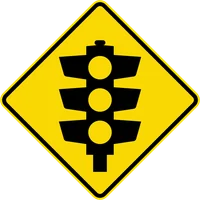
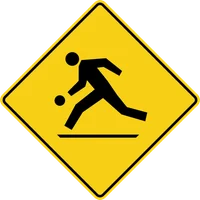
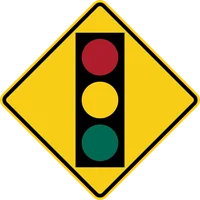
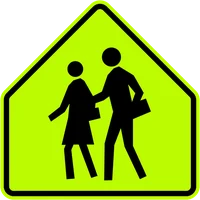
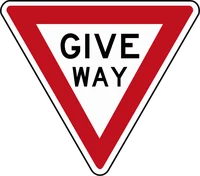
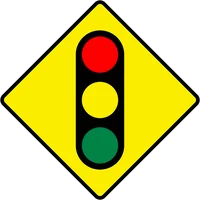
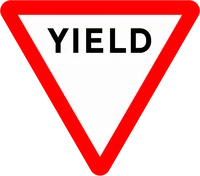
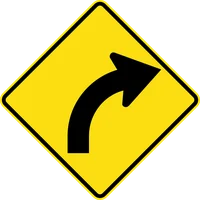
Warning signs tell you about a hazard before you can see it. For curves and other hazards ahead, the handbook's advice is to slow down before you reach the hazard, and to slow to the speed shown on the warning signs:
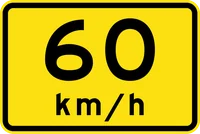
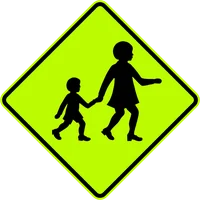
More in our Australian road signs list, and our general hazard perception guide explains how hazards develop.
The gaps and distances the handbook teaches
Two of the three HPT skills are about space: the gap you leave in front and the gap you accept in traffic. The handbook gives these as minimums for a 60 km/h zone:
| Situation | Gap the handbook asks for |
|---|---|
| Following another vehicle | At least 3 seconds; 4 or more in poor conditions and at night |
| Turning left out of a side street | At least 6 seconds (about 100 m) to traffic from the right |
| Turning right out of a side street | At least 4 seconds to the right (about 70 m), 6 seconds to the left (about 100 m), and 4 seconds to the front (about 70 m) where there's oncoming traffic |
| Turning right at traffic lights | At least 4 seconds (about 70 m) to oncoming traffic |
| Crossing an intersection | At least 3 seconds to the right (about 50 m) and 4 seconds to the left (about 70 m) |
| Beside other vehicles | At least 1 metre from moving or parked vehicles |
At higher speeds the gap is the same in seconds but longer in metres: at 80 km/h, a 6-second gap is about 135 m. The test for any gap is simple. If another driver has to slow down or change lanes because of you, it wasn't safe. The handbook stresses that these aren't hard and fast rules, and that you have to build the skill of judging gaps in real traffic.
How to count 3 seconds
Watch the vehicle in front pass a power pole, tree or sign, and say "one thousand and one, one thousand and two, one thousand and three". If you reach the same object before you finish, you're too close: drop back and count again. The handbook explains why 3 seconds: it takes about one and a half seconds to process a situation and another one and a half to act.
How to scan for hazards
New drivers tend to look only at the road just ahead. The handbook's scanning routine takes in the whole scene, 360 degrees around the car:
- Look up to 12 seconds ahead. That's about 200 m in a 60 km/h zone and 300 m at 90 km/h. Look through the windows of the cars in front, so you see brake lights come on several cars ahead.
- Check your mirrors every 8 to 10 seconds, inside and out.
- Head check your blind spots before you turn, merge or move left or right.
- Look for change. Your eyes are drawn to movement, but a stationary hazard, like a parked truck blocking your lane, can be the more urgent one.
- Listen too. You often hear a siren or a motorcycle before you see it, so keep the music down.
Then use the handbook's action plan: See the hazard, Think about what might happen and what you could do, Do something to stay safe. When you spot one, you can cover the brake, ease off the accelerator, slow down, or give it more room by changing your position or lane.
Think like the HPT: 6 practice scenarios
We wrote these ourselves from the handbook's guidance. They aren't official HPT clips, and we can't tell you how the real test would score them. Read each situation, decide what you'd do, then check.
- You're following a ute at 60 km/h on a 2-way road. It passes a power pole, and you reach the same pole by the time you've said "one thousand and one". Then it starts to rain.What to do: Slow down now, and keep dropping back until you can count to at least 3 seconds, more in the rain.Why: A 1-second gap is the handbook's example of too close. It asks for at least 3 seconds in good conditions and 4 or more in poor conditions and at night. Rear-end crashes are the most common crash for provisional drivers.
- You're waiting to turn left out of a side street onto a 60 km/h road. A car is coming from your right, about 4 seconds away, with nothing behind it.What to do: Wait. Let it pass, then go when the gap from the right is at least 6 seconds.Why: For a left turn in a 60 km/h zone, the handbook asks for at least 6 seconds (about 100 m) to traffic from the right. If the other driver has to brake or change lanes because of you, the gap wasn't safe.
- You're turning right at traffic lights on a green light with no arrow, in a 60 km/h zone. The first oncoming car is about 50 m away.What to do: Don't turn yet. Let it pass and look for a gap of at least 4 seconds (about 70 m).Why: The handbook says many provisional drivers crash turning right at lights because they pick gaps that are too small or misjudge how fast oncoming traffic is moving.
- You're driving down a 50 km/h shopping street lined with parked cars. Ahead, a parked car's brake lights come on and you can see someone in the driver's seat.What to do: Ease off, cover the brake and, if it's safe, move towards the right of your lane.Why: The car may pull out, or a door may open. The handbook says to assume the driver hasn't seen you until you've made eye contact, and to keep at least a metre from parked cars.
- A bus has stopped at a bus stop on your left and passengers are getting off.What to do: Slow down as you approach and be ready to stop.Why: Someone may cross the road in front of the bus, or the bus may pull out. The handbook uses this exact situation to show a driver slowing early.
- On a 100 km/h 2-way road you're stuck behind a slow truck. You can't see far past it, and an oncoming car is approaching in the distance.What to do: Stay behind it. Don't overtake.Why: The handbook warns that the HPT can show situations where overtaking would be unsafe, and you then don't touch the screen. A truck can be up to 3 times the length of a car, it blocks your view, and its advice on overtaking is not to do it unless you really have to.
How to prepare for the HPT: 7 tips
- Read the Hazard Perception Handbook. Transport for NSW says it's the only way to prepare for the HPT. Download it, or buy a copy at a service centre. Most of it is about the skills, not the test.
- Be wary of HPT practice websites. Transport for NSW says it has no connection with third-party practice tests, that some charge fees, and that they aren't the same as the NSW HPT and won't help you pass.
- Get lots of varied driving experience. The handbook is blunt: you can't learn hazard perception properly from a book or a website. Drive in different traffic, speeds, weather and at night.
- Start as a pedestrian and a passenger. The handbook suggests watching traffic from the footpath, then from the passenger seat with an experienced driver, then trying it yourself. One exercise: stand near a busy 60 km/h T-intersection, count 6 seconds to the left and 4 to the right, and judge whether you'd have accepted the gaps other drivers take when they turn right.
- Try commentary driving. With an experienced driver, take turns saying out loud where you're looking, what you see as hazards and what you'll do, then compare notes.
- Consider the Safer Drivers Course. If you're under 25 and have logged at least 50 hours (including 10 at night), it covers hazard awareness and adds 20 bonus hours to your log book.
- On the day, read each clip's instructions. Note what the driver wants to do, touch once when you would act, and don't touch if it isn't safe.
How Learner Lane helps, and what it isn't
Learner Lane is an independent app. It isn't connected to Transport for NSW or Service NSW, it doesn't replicate the NSW HPT or its scoring, and it can't guarantee a pass. Its hazard perception clips work differently from the official test: each 3D clip is generated fresh, you tap as a hazard starts to develop, and earlier taps score more. Use it to train your eyes to spot hazards early, alongside the handbook and real driving, not instead of them.
It also has 3D driving situations where you make the call, see the consequence and rewind, a road rules quiz, the road signs you'll meet, and a driving hours log for your supervised day and night hours. That log is a tracker, not an official log book, so keep recording in your paper log book or the Roundtrip app too. It's free to start, and a one-time Pass Pass purchase unlocks everything. Want to check your road rules too? Try the free Australia practice test.
Sources
- Transport for NSW: Hazard Perception Test (HPT)
- Service NSW: Book a hazard perception test (HPT)
- Transport for NSW: Hazard Perception Handbook (PDF, edition 01/23)
- Transport for NSW: Driver and rider licence fees
- Transport for NSW: Learner driver licence
- Transport for NSW: Provisional P1 licence
- Transport for NSW: The Driving Test
- Transport for NSW: Tests and practice tests for drivers
- Transport for NSW: Using your learner driver log book
- Transport for NSW: NSW Safer Drivers Course
Checked 6 November 2026. Fees are those effective from 1 July 2026. Learner Lane is not affiliated with Transport for NSW or Service NSW.
This guide summarizes common rules. Laws vary by country, state and province, and change over time: check your official driver handbook. Learner Lane is not affiliated with any government licensing authority.