G1 practice test (Ontario): pass mark, what to bring and 10 questions
· 10 min read
The G1 test is the written knowledge test you pass to get your first Ontario driver's licence. It's a multiple-choice test on the rules of the road and traffic signs, taken with a quick vision test at a DriveTest centre. Here's what's on it, the pass mark, what to bring, what changes once you hold a G1, and 10 practice questions we wrote from the Official MTO Driver's Handbook so you can check where you stand.
What is the G1 test?
Ontario uses graduated licensing: you hold a G1, then a G2, before you get a full G licence. The G1 test is the first step. To apply for a licence you must be at least 16 years old and an Ontario resident, pass a vision test, and pass a test of your knowledge of the rules of the road and traffic signs. Pass both and you leave with a G1 and are considered a beginner driver.
You can take the test at any DriveTest centre without an appointment, or by appointment at the ServiceOntario location at Bay and College in downtown Toronto.
| G1 knowledge test | Details |
|---|---|
| Minimum age | 16 |
| What's tested | Rules of the road and traffic signs, all multiple choice |
| Sections | Typically two or three, such as one on signs and one on rules of the road |
| Time | Typically 20 to 30 minutes |
| Pass mark | At least 80% |
| Vision test | Taken when you apply: 20/50 or better, with or without glasses or contacts |
| Where | Any DriveTest centre (no appointment), or ServiceOntario Bay and College (by appointment) |
| Fee | One fee covers the knowledge test, your first road test and a five-year licence |
How many questions are on the G1 test?
DriveTest's knowledge test page describes the G1 test by its sections and pass mark rather than a published question count. Each knowledge test typically has two or three sections, such as one on signs and one on rules of the road, and takes 20 to 30 minutes. The handbook's sample questions page confirms that every question uses the same multiple-choice format.
Expect two kinds of questions:
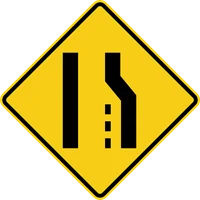
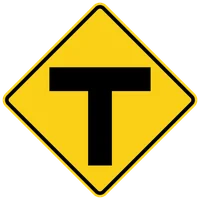
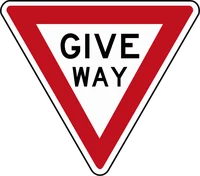
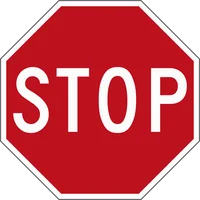
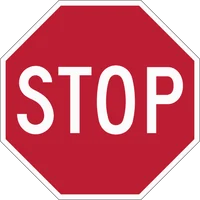
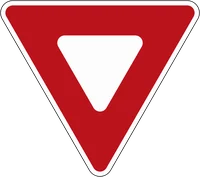
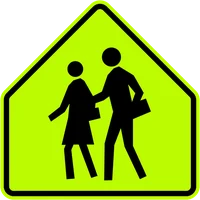
- Signs. What a sign means, which you can often work out from its shape and colour before you read a word.
- Rules of the road. Right of way, speed limits, stopping distances, lights, emergencies and the licence rules themselves. The handbook's own sample questions even include one on lending your licence.
G1 test pass mark
You need a score of at least 80% to pass. The sections matter: DriveTest says that if you retry within one year, you only redo the sections that didn't meet the Ministry's standard. So don't lean on a strong signs score to carry a weak rules section. Prepare for both.
If you don't pass, you can pay the fee for another attempt and take the test again. Each extra attempt is charged separately.
How much does the G1 test cost?
You pay one fee when you apply. The Official MTO Driver's Handbook says it includes the cost of the knowledge test, your first road test and a five-year licensing fee. Fees are set by the province and change from time to time, so check the current amount on DriveTest's fee list before you go. You can pay by cash, debit or credit card.
What to bring to the G1 test
- Original, valid ID that shows your legal name and full date of birth (day, month and year). Photocopies and expired documents aren't accepted. For Canadian citizens, accepted documents include a passport (Canadian or foreign), a Canadian Citizenship Card with photo, a Secure Certificate of Indian Status Card and an Ontario Photo Card. Permanent and temporary residents have their own lists on DriveTest.
- Money for the test fees: cash, debit or credit card.
- Glasses or contact lenses, if you need them to drive.
The handbook's test-day checklist lists two pieces of identification, so bring a second document to be safe.
The vision test
You take a short vision test when you apply. Ontario's standard for a G licence is visual acuity no worse than 20/50 and a horizontal field of vision of at least 120 continuous degrees, tested with both eyes open, with or without glasses or contact lenses. If you don't meet the field-of-vision standard, the Ministry decides whether you can apply for a vision waiver.
After you pass: G1 rules
A G1 lets you practise, not drive on your own. These conditions apply for your whole time at Level One:
- Zero alcohol. Your blood-alcohol level must be zero.
- Never drive alone. An accompanying driver sits in the front passenger seat. They need a Class G (or higher) licence, at least four years of driving experience and a blood-alcohol level under .05%, and they're the only other person allowed in the front seat.
- A working seatbelt for everyone in the vehicle.
- No 400-series highways with a posted limit over 80 km/h, and no high-speed roads such as the Queen Elizabeth Way, Don Valley Parkway, Gardiner Expressway, E.C. Row Expressway and Conestoga Parkway. If your accompanying driver is a driving instructor, you may drive on any road.
- No driving between midnight and 5 a.m.
When can you take the G2 road test?
You can take your first road test, the G2, after 12 months with a G1. Graduating from an approved beginner driver education (BDE) course cuts four months off, so you can take it after eight months. Pass it and you move to Level Two.
| Level | How long | To move up |
|---|---|---|
| G1 | 12 months, or 8 with an approved course | Pass the G2 road test |
| G2 | At least 12 months | Pass the road test for a full G licence |
| Whole process | At least 20 months, and no more than 5 years | Not done in 5 years? You start over |
At Level Two your blood-alcohol level must still be zero and everyone needs a working seatbelt. If you're 19 or under, there are limits on young passengers between midnight and 5 a.m.: one passenger aged 19 or under in your first six months, then up to three, unless a fully licensed driver is in the front seat or the passengers are immediate family.
G1 practice questions (with answers)
We wrote these 10 questions ourselves from rules stated in the Official MTO Driver's Handbook. They aren't from the real test, but they check the kind of facts it covers: numbers, right of way and G1 conditions. Answer each one before you open the answer.
- You have your G1. Who is allowed to sit in the front passenger seat while you drive?A. Any passenger with a working seatbeltB. A driver with a Class G (or higher) licence and at least four years of driving experienceC. Any licensed driver aged 18 or overD. Nobody: G1 drivers must drive alone
Show answer
B. Your accompanying driver must have a Class G (or higher) licence, at least four years of driving experience and a blood-alcohol level under .05%, and they're the only person allowed in the front seat with you. - With a G1 licence, during which hours are you not allowed to drive?A. 11 p.m. to 6 a.m.B. Midnight to 5 a.m.C. Sunset to sunriseD. 1 a.m. to 6 a.m.
Show answer
B. G1 drivers must not drive between midnight and 5 a.m. - There are no speed limit signs on a street in a town. What is the maximum speed?A. 40 km/hB. 50 km/hC. 60 km/hD. 80 km/h
Show answer
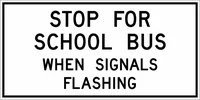
B. Where no limit is posted, the maximum is 50 km/h in cities, towns and villages, and 80 km/h elsewhere. - You come up behind a school bus that has stopped with its red lights flashing. Where do you stop?A. At least 5 metres behind itB. At least 10 metres behind itC. At least 20 metres behind itD. You don't have to stop if you pass slowly
Show answer
C. Stop at least 20 metres away, and don't go until the bus moves or its lights stop flashing. - A train is coming as you approach a railway crossing. Where must you stop?A. At least 5 metres from the nearest rail or gateB. Right up against the gateC. At least 2 metres from the nearest railD. Anywhere, as long as you're off the tracks
Show answer
A. Stop at least five metres from the nearest rail or gate, and don't cross until you're sure the train or trains have passed. - You and another driver stop at an all-way stop at the same moment. The other car is on your right. Who goes first?A. You doB. The car on your rightC. Whoever is going straightD. Whoever signals first
Show answer
B. If two vehicles stop at the same time, the vehicle on the left must yield to the vehicle on the right. - At night, you must switch to low beams when an oncoming vehicle is within:A. 60 metresB. 100 metresC. 150 metresD. 300 metres
Show answer
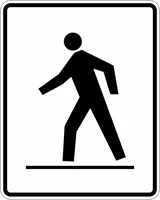
C. Use low beams within 150 metres of an oncoming vehicle, and when you're following a vehicle within 60 metres. - A pedestrian is crossing in front of you at a pedestrian crossover. When may you drive on?A. Once they've passed the front of your carB. Once they reach the middle of the roadC. Once they've completely crossed the roadD. As soon as the lane beside you starts moving
Show answer
C. At a pedestrian crossover you must yield and wait for pedestrians to completely cross the road. - A fire truck passes you on its way to an alarm. How closely may you follow it?A. No closer than 50 metresB. No closer than 100 metresC. No closer than 150 metresD. As close as you like
Show answer
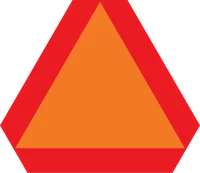
C. It's illegal to follow within 150 metres of a fire vehicle responding to an alarm. - There's an orange triangle with a red border on the back of the vehicle ahead. What does it tell you?A. It's carrying dangerous goodsB. It will be travelling at 40 km/h or lessC. A learner is drivingD. It's a wide load
Show answer
B. That's the slow-moving vehicle sign: the vehicle will be travelling at 40 km/h or less, so be ready to slow down early.
Got them all? Keep going with the free Canada practice test and the Canada road signs guide. For the all-way stop and yield-to-the-right logic step by step, read our 4-way stop rules and right-of-way rules guides.
7 tips to pass the G1 test
- Study the official handbook. The Official MTO Driver's Handbook is free to read on ontario.ca, or you can buy a copy for $14.95 plus taxes. Read the "Getting Your Driver's Licence" chapter too: the G1 and G2 rules are in it.
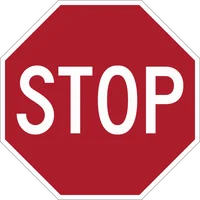
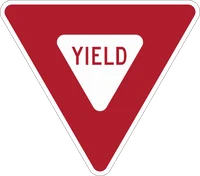
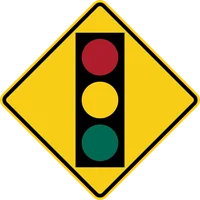
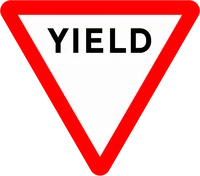
- Learn signs by shape and colour. Eight-sided red means stop, a red-bordered triangle means yield, a five-sided sign means school zone, yellow diamonds warn, orange diamonds mean temporary conditions such as construction, and an X-shaped sign marks a railway crossing. On regulatory signs, a green circle means you may or must do the action, and a red circle with a line through it means you can't.
- Make a list of the numbers. 50 km/h in towns and 80 km/h elsewhere when no limit is posted, a two-second following distance, 20 metres behind a stopped school bus, 5 metres from a railway crossing, low beams within 150 metres of oncoming traffic, and 150 metres behind a fire truck on a call.
- Don't neglect either section. Practise signs and rules separately so one doesn't drag the other down.
- Read every word. Many wrong answers come from missing "not" or "except", or picking the answer you expected to see.
- Take practice tests until 80% feels easy. Aim well above the pass mark so nerves on the day don't matter.
- Bring the right ID and your glasses. Original, unexpired documents only, and glasses or contacts if you need them to drive.
How Learner Lane helps, and what it isn't
Learner Lane is an independent iOS app. It isn't affiliated with the Ministry of Transportation or DriveTest, and its questions aren't taken from the real test. What it does is teach the rules inside short 3D driving situations: you make the call, see the consequence, and rewind. Chapters cover road signs, traffic lights, right of way, weather and night driving, and sharing the road, set up for Canada with real Canadian signs. It also has road rules quiz questions, a supervised driving log for your day and night hours during your G1 year, and practice routes on real roads around your test centre with turn-by-turn voice directions. It's free to start, and a one-time Pass Pass purchase unlocks everything.
Facts from ontario.ca: Getting Your Driver's Licence (Official MTO Driver's Handbook), Get a G driver's licence: new drivers and Medical review for Ontario drivers, and DriveTest's knowledge test page, checked 27 October 2026. Rules and fees change, so check them before your test. Learner Lane is not affiliated with the Ontario Ministry of Transportation or DriveTest.
This guide summarizes common rules. Laws vary by country, state and province, and change over time: check your official driver handbook. Learner Lane is not affiliated with any government licensing authority.