Yield sign: what it means and what to do
· 5 min read
The yield sign is one of the first signs you'll learn for your permit test, and one of the most misunderstood on the road. It doesn't mean stop, and it doesn't mean go. It means someone else has the right of way, and it's your job to fit in around them. Here's exactly what to do, how it differs from a stop sign, and the other yield signs you'll see.
What does a yield sign mean?
A yield sign tells you that traffic on the road you're entering has the right of way. The California Driver Handbook puts it simply: slow down and be ready to stop to let any vehicle, bicyclist or pedestrian pass before you proceed. Other states word it differently, but the idea is the same everywhere: you give way, they don't.
Engineers use a yield sign where a full stop isn't always needed. If the way is clear, you can keep rolling. That's the key difference from a stop sign.
What does a yield sign look like?
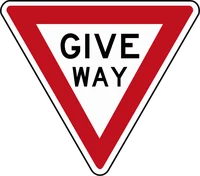
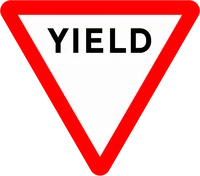
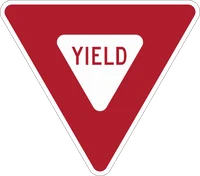
In the US, a yield sign is a downward-pointing triangle with a wide red border and the word YIELD in red on a white background. Federal sign rules (the MUTCD) reserve that shape for the yield sign alone, just as the octagon is reserved for STOP. That's deliberate: you can recognize the sign from its shape when it's covered in snow, or even from the back. Expect a shape question on your permit test.
What to do at a yield sign, step by step
- Ease off the gas early. Slow to a speed where you could stop comfortably if you had to.
- Scan the road you're entering. Look left, right and left again. At a merge or a roundabout, look at the traffic you're joining.
- Check the crosswalks. A pedestrian in or stepping into the crosswalk goes before you.
- Stop in the right place if you must. Stop at the yield line if there is one. If there isn't, stop before the crosswalk, or before you enter the intersection.
- Go when the gap is safe, without forcing anyone else to brake or swerve.
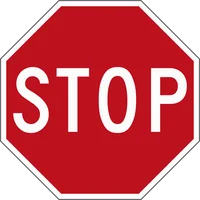
Yield sign vs stop sign
Both signs mean someone else may have the right of way. The difference is whether you must stop every time.
| Stop sign | Yield sign | |
|---|---|---|
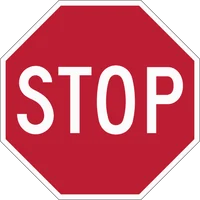
| Shape | Red octagon | Red and white triangle, point down |
| Must you stop? | Always, a complete stop | Only if traffic or pedestrians are coming |
| Where you stop | At the stop line or before the crosswalk | At the yield line or before the crosswalk |
| Right of way | Yield after stopping | Yield, with or without stopping |
| Common places | Intersections, all-way stops | Roundabout entries, merges, side roads |
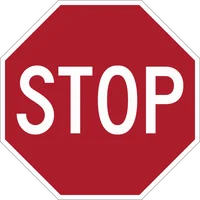
One more difference: a yield sign is never put on every approach to an ordinary intersection, the way stop signs are at a 4-way stop. The one exception is a roundabout, where every entry has a yield sign. For the order of turns at an all-way stop, see 4-way stop rules.
Where you'll see yield signs
- Roundabout entrances. Every entry to a roundabout has one. Yield to all traffic already in the roundabout, then enter when there's a big enough gap.
- Merges and on-ramps. Where your lane joins another road, traffic already in those lanes has the right of way.
- Side roads joining a main road, where a full stop isn't always needed.
The yield ahead sign
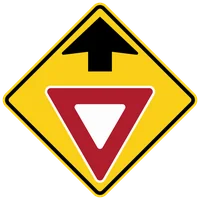
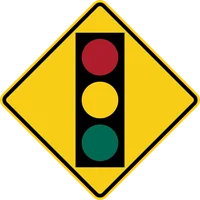
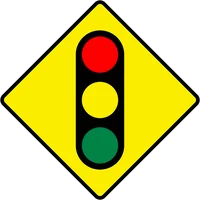
A yellow diamond with a small yield sign on it is a yield ahead warning. It's put up when the yield sign itself is hidden, by a curve, a hill or trees, and you wouldn't see it in time to react. When you see one, slow down early and get ready to give way. The same family includes stop ahead and signal ahead signs.
Yield here to pedestrians and other yield signs
The word YIELD turns up on several other signs. Each one tells you who to give way to, and where.
Yield here to pedestrians
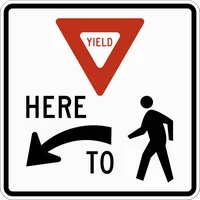
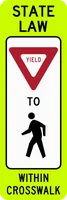
You'll see this sign at crosswalks, often in the middle of a block, with a row of white triangles painted across the lane well before the crosswalk. Federal guidance places the sign 20 to 50 feet ahead of the crosswalk. If someone is crossing, stop at the triangles, not right at the crosswalk. Stopping back gives drivers in the next lane a clear view of the pedestrian too.
Left turn yield on green
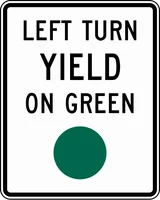
On a plain green light, you may turn left, but oncoming traffic and pedestrians in the crosswalk go first. Wait in the intersection with your wheels straight and turn when there's a safe gap.
Shark's teeth: the yield line
A yield line is a row of solid white triangles across the lane, pointing toward you. People call them shark's teeth. They mark where to stop if you have to yield. When they're painted ahead of a crosswalk, a yield here to pedestrians sign must go with them. You'll often see them at roundabout entries and other yield signs too.
Failure to yield
"Failure to yield" means not giving the right of way to someone who has it. It's a traffic violation in every state, and the penalties vary from state to state. The situations where learners most often get it wrong:
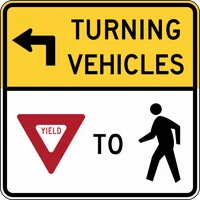
- Pedestrians. Give way to pedestrians in a crosswalk, marked or not, including when you're turning.
- Left turns on a green light. Oncoming traffic goes first unless you have a green arrow.
- Merging and entering traffic. Traffic already in the lanes has the right of way.
- Roundabouts. Traffic already circulating goes first.
- Emergency vehicles. When one approaches with lights and siren, pull over to the right and stop.
The exact wording of right-of-way laws differs between states, so check your state's driver handbook before your test. On the road test, examiners watch for a visible check of traffic and crosswalks as you approach a yield sign. Turn your head so they can see you look.
Test yourself
Yield signs and right-of-way questions appear on every state's permit test. Try the free US practice test, take the road signs test, and see every regulatory, warning and guide sign in the US road signs guide.
This guide summarizes common rules. Laws vary by country, state and province, and change over time: check your official driver handbook. Learner Lane is not affiliated with any government licensing authority.