ICBC knowledge test: questions, pass mark, cost and practice questions
· 10 min read
The ICBC knowledge test is the multiple-choice test you pass to get your learner's (L) licence in British Columbia. You can take it online or at a driver licensing office, and every question is based on ICBC's free Learn to Drive Smart guide. Here's the format, the pass mark, the cost, what to bring, the L rules (some changed on October 19, 2026), and 10 practice questions we wrote from Learn to Drive Smart.
What is the ICBC knowledge test?
It's the first step in B.C.'s Graduated Licensing Program (GLP). To get your learner's licence, you pass the knowledge test and a vision screening. You can get your L on or after your 16th birthday, and if you're under 18, a parent or legal guardian has to sign consent. (ICBC's online test page still says under 19, so check the consent rules when you book.)
| ICBC knowledge test | Details |
|---|---|
| Questions | 50, multiple choice, including road signs |
| Pass mark | 40 out of 50 (80%) |
| Based on | Learn to Drive Smart, ICBC's free guide |
| Where | Online, or at any ICBC driver licensing location |
| Online limits | Start within 72 hours of registering; 45 minutes in one session |
| Fees (Oct 2026) | $15 for the test, $10 for the Class 7L photo licence |
| Before you're licensed | Vision and medical screening, two pieces of ID |
| Results | Valid for one year |
How many questions are on the ICBC knowledge test?
There are 50 multiple-choice questions that test how well you know Learn to Drive Smart. Some of them are about road signs, which is why ICBC suggests taking its road signs practice test too. At a driver licensing office, the test is available in English, French, Arabic, Cantonese, Croatian, Farsi, Mandarin, Punjabi, Russian, Spanish, Ukrainian and Vietnamese.
ICBC knowledge test pass mark
You need 40 out of 50 correct to pass: 80%, or no more than 10 wrong. Don't let that margin relax you. ICBC's own preparation sheet warns that the test is harder than you may think, and that many questions are designed to need thinking and understanding, not just memorized facts.
How much does the ICBC knowledge test cost?
At the time of writing (October 2026), ICBC's preparation sheet lists $15 for the knowledge test, whether you take it online or in office, and $10 for your Class 7L photo learner's licence. If you test online, you pay the $15 when you register, then pay the licence fee separately when you visit an office. Fees change, so check icbc.com before you go.
Taking the ICBC knowledge test online
You can take the passenger vehicle knowledge test online. The steps:
- Register and pay the $15 fee online.
- Start within 72 hours of registering. You have 45 minutes to finish, in a single session.
- Visit a driver licensing office to get your licence. Passing online doesn't mean you're licensed or allowed to drive yet. Depending on the office, you may need to book a 10-minute appointment.
Your test results are valid for one year.
What to bring
Whether you test in person, or visit an office after passing online, bring:
- Two pieces of accepted ID. If you tested online, one must be the same primary ID you used to register.
- A signed parent or guardian consent form, if you need one. A parent or guardian can also sign it at the office.
- Your glasses or contact lenses, if you wear them, for the vision screening.
- Your pass confirmation email, printed or on your phone, if you tested online.
- Payment for the test and licence fees.
If you're testing in person, arrive early. Most driver licensing offices offer the knowledge test without an appointment, but ICBC says they may not be able to test everyone when it's busy.
Vision and medical screening
Before you get your L, you pass a simple vision and medical screening to make sure you're in good enough shape to drive. Chapter 9 of Learn to Drive Smart, "your licence", explains it in more detail.
L licence restrictions in B.C.
Once you pass, you hold a Class 7L learner's licence. Some rules changed on October 19, 2026, including the supervisor's minimum age and the passenger limit. Here are the rules now:
| Rule | What it means |
|---|---|
| Supervisor | A qualified supervisor sits beside you in the front passenger seat. They must be at least 22 (it was over 25 before October 19, 2026), hold a valid Class 1 to 5 licence without the new-driver zero alcohol and drug restriction, and be legally able to drive. |
| Passengers | One passenger besides your supervisor. Since October 19, 2026, you can carry more if all the others are immediate family. |
| Hours | No driving between midnight and 5 a.m. |
| L sign | Display the red L sign on the back of your vehicle. |
| Alcohol and drugs | Zero alcohol or drugs in your blood when you drive. |
| Phones and devices | No cellphones or other electronic devices, including hands-free. |
After your L: the road test and your N
To get your novice (N) licence, you pass the Class 7 road test. How long you must hold your L first depends on your age, and the GLP changed on October 19, 2026, so check ICBC's graduated licensing page for your minimum before you book.
The second road test is gone. Since October 19, 2026, N drivers with a clean record take a Driving Record Assessment instead, followed by a 12-month restriction period on a Class 5 licence. If you're under 25, you need at least 24 months of safe driving as an N first (18 if you completed an approved GLP course during your L). At 25 or older, it's 12 months. ICBC's GLP changes page has the details.
ICBC practice test: 10 questions to try
Start with ICBC's own free practice knowledge test. ICBC says its questions are based on the real test, and you can take it as many times as you want, in a browser or the ICBC app.
Then try these 10. We wrote them ourselves from rules stated in Learn to Drive Smart, with extra weight on rules that are specific to B.C. They aren't from the real test. Answer each one before you open the answer.
- Unless a sign says otherwise, what's the maximum speed in a lane or alley inside a B.C. city or town?A. 10 km/hB. 20 km/hC. 30 km/hD. 50 km/h
Show answer
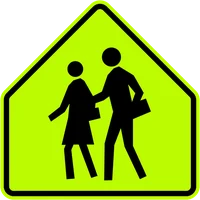
B. 20 km/h is the maximum in a lane or alleyway within a municipality unless otherwise posted. Other unposted roads are 50 km/h in cities and towns and 80 km/h outside them. - A school zone sign has a 30 km/h tab underneath but no hours. When does the 30 km/h limit apply?A. 24 hours a day, every dayB. 8 a.m. to 5 p.m. on school daysC. From dawn to dusk every dayD. Only when you can see children
Show answer
B. When the tab shows only the speed limit, it's in effect from 8 a.m. to 5 p.m. on school days. - When does a 30 km/h playground zone limit apply?A. 8 a.m. to 5 p.m. on school daysB. Every day from dawn to duskC. Only on weekends and holidaysD. Only in July and August
Show answer
B. Playground zone limits are in effect every day from dawn to dusk. - In B.C., what does a flashing green traffic light mean?A. You have a protected left turnB. It's a pedestrian-controlled light: go only if the intersection is clearC. Treat the intersection as a four-way stopD. The light is about to turn red
Show answer
B. A flashing green is controlled by pedestrians, who can press the button and change it to yellow and then red. Side-street traffic faces a stop sign and may be waiting to cross. - You're driving toward a stopped school bus from the front, and the red lights at its top are flashing. What must you do?A. Slow down and pass with careB. Stop, because you must stop whether you're in front of or behind the busC. Stop only if children are on your side of the roadD. Sound your horn and keep going
Show answer
B. When a school bus shows alternating flashing red lights, you must stop whether you're approaching from the front or the rear. Vehicles in all lanes must stop. - The speed limit is 90 km/h and a tow truck is stopped on the shoulder with its lights flashing. What's the fastest you may pass it?A. 40 km/hB. 60 km/hC. 70 km/hD. 80 km/h
Show answer
C. Where the limit is 80 km/h or more, pass no faster than 70 km/h (40 km/h where it's under 80 km/h), and move out of the lane next to it if it's safe. - In good weather and road conditions, what's the minimum following distance?A. One secondB. Two secondsC. Five secondsD. One car length
Show answer
B. Leave at least two seconds in good conditions, three on high-speed roads and four in bad weather or on slippery or uneven roads. - At a four-way stop, you and an oncoming car arrive at about the same time. You're turning left; they're going straight. Who goes first?A. You, because you signalledB. The oncoming car going straightC. Whoever is on the rightD. Whichever vehicle is bigger
Show answer
B. When two vehicles facing each other arrive at about the same time, the one turning left yields to the one going straight through. - How close to a fire hydrant can you legally park?A. No closer than 3 metresB. No closer than 5 metresC. No closer than 10 metresD. Anywhere, if you stay in the car
Show answer
B. It's illegal to park within five metres of a fire hydrant, measured from the point on the curb beside it. - You reach a traffic circle at the same time as another vehicle. Who goes first?A. You, if you're going straightB. The vehicle on your rightC. The vehicle on your leftD. Whoever is going faster
Show answer
B. Yield to any traffic already in the circle, and if you arrive at the same time as another vehicle, yield to the one on your right. Then go around counter-clockwise.
Want more? Take the free Canada practice test, browse the Canada road signs guide, and read our right-of-way rules and 4-way stop rules guides for the logic behind who goes first.
7 tips to pass the ICBC knowledge test
- Study Learn to Drive Smart. It's free, and ICBC says all the questions are based on it. You can download it or pick up a copy at a driver licensing office.
- Learn the B.C. rules that catch people out. A flashing green light is pedestrian-controlled, lanes and alleys are 20 km/h, playground zones run dawn to dusk every day, and you stop for a school bus's flashing red lights from either direction.
- Know the numbers. 50 km/h in towns and 80 km/h outside them when nothing is posted, 70 or 40 km/h past stopped vehicles with flashing lights, 150 metres behind a fire truck, and a two-second following distance.
- Take both ICBC practice tests. The practice knowledge test and the road signs practice test cover the two kinds of questions you'll see.
- Understand, don't just memorize. Learn why each rule exists, so you can apply it to a situation you haven't seen before. Picture yourself in the driver's seat.
- Take your time. Read through each question fully. Watch for words like "not" and "except".
- Plan the online session. You get 45 minutes in one go, so pick a quiet time and place, and start within 72 hours of registering.
How Learner Lane helps, and what it isn't
Learner Lane is an independent iOS app. It isn't affiliated with ICBC, and its questions aren't taken from the real test or from Learn to Drive Smart. What it does is teach the rules inside short 3D driving situations: you make the call, see the consequence, and rewind. Chapters cover road signs, traffic lights, right of way, weather and night driving, and sharing the road, set up for Canada with real Canadian signs. It also has road rules quiz questions, a supervised driving log for your day and night hours as an L, and practice routes on real roads around your test centre with turn-by-turn voice directions. It's free to start, and a one-time Pass Pass purchase unlocks everything.
Facts from icbc.com: Get your L, Take the online knowledge test, You have a Class 7L licence, Graduated licensing, Changes to the Graduated Licensing Program, the Preparing for your driver licensing tests sheet (MV2022) and Learn to Drive Smart, checked 27 October 2026. Rules and fees change, so check them before your test. Learner Lane is not affiliated with ICBC.
This guide summarizes common rules. Laws vary by country, state and province, and change over time: check your official driver handbook. Learner Lane is not affiliated with any government licensing authority.